AI can help drive direct sales. But not on its own.
SCROLL

In recent months, a two-sided idea has gained traction. On the one hand, some in the industry argue that the rise of AI in search engines and virtual assistants could further undermine the visibility of the direct channel. On the other hand, optimistic voices are emerging, claiming that AI “favors” direct sales and that hotels will finally be able to regain ground against OTAs.
The most recent data does suggest that when an AI assistant decides to recommend a hotel and include a link, the property’s official website is highly likely to be the final destination of the click. But that doesn’t mean that any drop in organic traffic is AI’s fault, nor that direct sales will grow on their own. In short: the direct channel now has a clear opportunity, provided the hotel is prepared to take advantage of it.
Key Point 1: The Source and the Destination Are Not the Same
The AI Hotel Landscape 2026 study by Hotelrank.ai offers a key insight for understanding the new landscape: AI models rely heavily on third-party sources to determine which hotels to display, but when generating a final link, they favor the official website.
This conclusion is important because it debunks a very common misconception: the idea that if OTAs are dominant as a source, they will also be dominant as the click destination. The report shows exactly the opposite. Intermediaries continue to play a major role in the discovery and validation phase, but the official website takes center stage in the conversion phase.
This aligns with how these systems actually work. AI compares and contrasts information from multiple sources to ensure a distributed reputation (via OTAs, aggregators, reviews, etc.). But when it detects a clear and reliable official website, it tends to link to the hotel’s primary source.
What the data shows
Hotelrank.ai reports that the share of direct links to the hotel’s website ranges from approximately 75% to 91%, depending on the model analyzed. GPT 5.2 appears to be the most direct-link-oriented, while in Perplexity, for example, intermediate links carry greater weight. Even so, the official website continues to play a dominant role as the final destination.
This data is relevant but does not imply that AI is “anti-OTA.” Rather, it reflects that OTAs are fulfilling two distinct functions:
- They help models understand which hotels exist, how they are positioned, and how users rate them.
- They compete less when deciding which link to send to the user.
A click does not guarantee a booking
This is where some industry messages become overly optimistic. The fact that AI displays a link to the official website does not directly prove an increase in direct sales. There is a gap between the click and the booking that must be taken into account. Everything plays a role—from the product offered to the price, trust, and user experience, as well as commercial clarity and the consistency of the digital ecosystem.
Furthermore, there is another factor that complicates the picture: on Google, the experience does not always lead to the website. In Hotelrank.ai’s study on Google AI Mode, most interactive links go to the Google Business Profile. From there, the direct link appears, along with other results that the user can continue to compare.
The direct channel no longer competes solely in the classic SERP; it also competes in the listing, in the hotel module, in data consistency, and in the experience the user encounters upon landing.
Key Point 2: AI Can Indeed Reduce Organic Clicks
While we’re seeing the official website potentially take center stage, there’s also evidence that AI-powered experiences reduce the need to click.
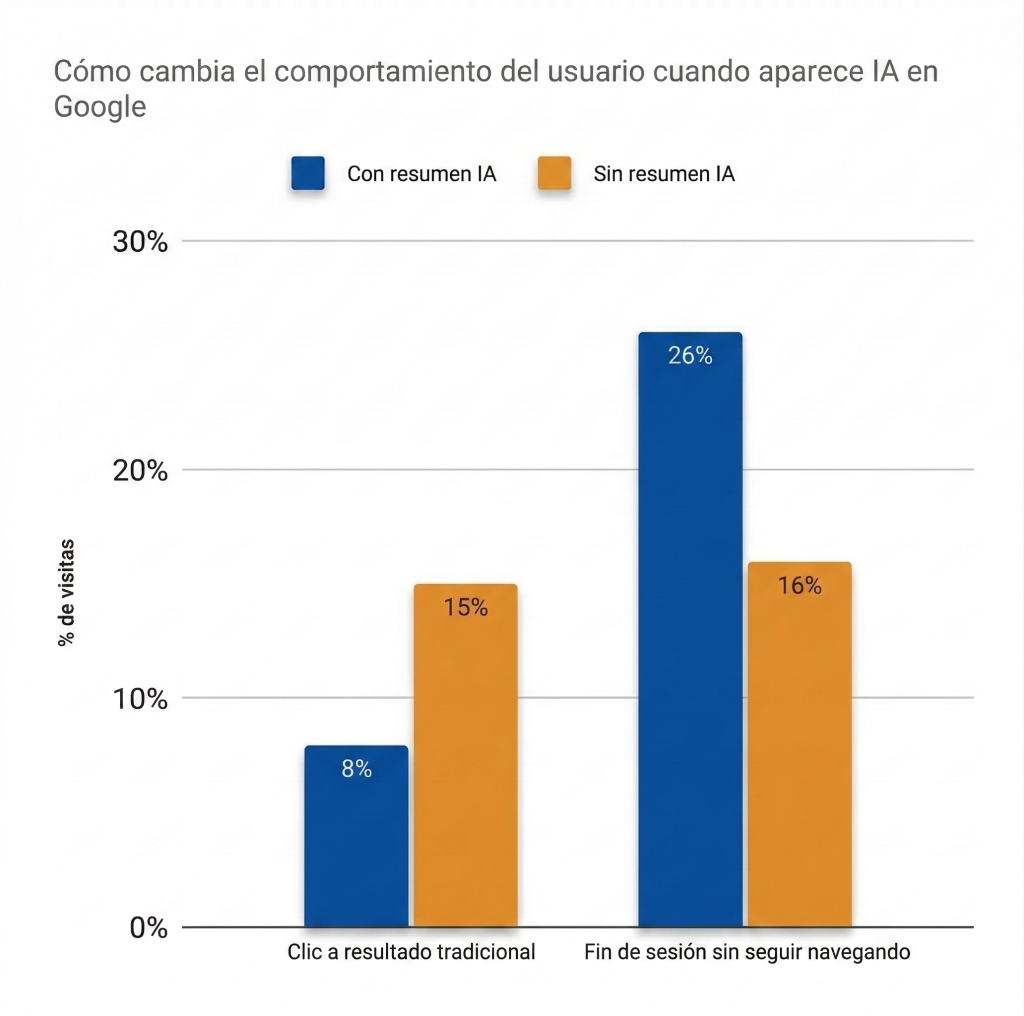
Pew Research reported that when an AI-generated summary appears on Google, users are less likely to click on traditional search results. The percentage of sessions that end without users navigating to other sites also increases.
This aligns with what many teams are seeing in Search Console: more impressions in certain search universes, but fewer relative clicks. This is especially true for informational, inspirational, or early comparison queries.
That’s why it would be a mistake to settle for an overly optimistic narrative like “AI drives direct sales.” It may do so in the final stage of the conversion funnel, but at the same time, it can reduce the total volume of available clicks.
What’s Really Happening with Organic Hotel Traffic
Looking at the big picture, AI brings about at least four changes:
- It reduces the volume of informational clicks
- It reorders authoritative sources
- It may give greater prominence to the hotel’s link once it has selected it as the best option
- It increases the importance of click quality. Users arrive with more specific search criteria and clearer expectations.
Therefore, when analyzing the decline in organic traffic solely in relation to AI, it’s important to make a clear distinction between:
- Brand vs. non-brand
- Informational vs. transactional queries
- Traffic to inspirational pages vs. traffic to sales pages
- Impressions vs. CTR
- Organic clicks vs. sessions with actual conversion potential
Google, in fact, indicates that traffic from AI Overviews and AI Mode is grouped under the “Web” category in Search Console. This means that if we don’t analyze it precisely, the impact of AI gets mixed in with the rest, making it easy to over- or under-attribute the phenomenon.
The website comes into play
In an environment where AI tends to streamline responses, the official website can no longer simply “be present.” It must justify why it deserves to be the final destination.
And here lies an advantage that OTAs cannot match: the ability to create desire.
- An OTA listing compares. A proprietary website can entice.
- An OTA organizes inventory. A proprietary website can express identity.
- An OTA facilitates filtering. A proprietary website can elevate the perception of value.
This is a strategic element. AI may drive the click, but the final decision still depends on the human factor. The hotel’s website must act as a sales pitch: conveying personality, organizing information, and showcasing attributes as benefits that turn a search into a preference.
The website with the most potential isn’t just the “prettiest” one. It’s the one that combines four layers:
1. Authority layer
It is recognized as an official source, crawlable, technically sound, and well-structured.
2. Commercial layer
It clearly explains the value proposition, the benefits of direct booking, the terms and conditions, flexibility, extras, and the reason to book there.
3. Emotional layer
It captivates the eye. It’s not enough to simply list rooms and services; you have to convey atmosphere, context, style, and experience.
4. External consistency layer
It is aligned with what the hotel projects on OTAs, local listings, reviews, and other platforms where AI also learns.
The great opportunity lies in leveraging all four layers. In this way, AI becomes an ally of the direct channel.
How a hotel can benefit from this change
Rather than chasing an “AI trick,” it’s better to focus on the fundamentals:
- Improve your reputation and the information displayed on OTAs and third-party sources
- Strengthen your official website as a primary, useful, and reliable source
- Develop content with commercial and semantic intent
- Review actual sales capacity, not just its appearance
- Measure the impact in terms of business, not just traffic
The question to answer is: “When AI presents me with an opportunity, does my website know how to turn it into a result?”
Conclusion
AI does not eliminate intermediaries. Nor does it, on its own, guarantee more direct sales. But it can open up a new window of opportunity for the direct channel.
The key lies in fully understanding how the roles are divided: OTAs continue to influence the user’s choice, but the official website has the opportunity to secure the final booking. Therefore, conversion depends on it functioning as a true sales channel.
The most useful conclusion isn’t “AI will save us,” but rather seeing it as an ally of the direct channel. To take advantage of it, the hotel must ensure it is well-positioned within its ecosystem and that its official website is truly ready to sell. If it isn’t, that space will continue to be captured by a third party.
Now is the time to check this. At Emexs, we focus on evaluating the official website, reputation, and visibility in AI to ensure you’re taking advantage of this opportunity.