Disparities: the silent reason why AI doesn't make recommendations to you
SCROLL
If you ask a hotel marketing manager what the most common obstacle is in their efforts to drive direct bookings, price disparity will be among the top answers. It’s one of the industry’s most persistent problems: you can have an excellent website, a well-maintained reputation, and a solid investment in customer acquisition, and still lose the booking at the very last minute because the same hotel appears to be cheaper on another channel.
And despite its impact, it almost never receives the priority it deserves. Not because of a lack of interest, but because of a lack of technical expertise: monitoring parity across dozens of channels simultaneously and in real time is genuinely difficult. It also exists at the intersection of Marketing and Revenue, one suffers from it in direct sales, the other has the leverage to correct it, and without precise and continuous technical monitoring, it slips through the cracks. Manual and occasional checks aren’t enough for a problem that changes every day. And now, on top of that, it comes with a new cost.
Because for two decades, price discrepancies were a problem between you and the OTA. A broken contract, a rate that somehow ended up cheaper on one channel, a call from the account manager. Annoying, but limited: it was your margin that took the hit.
With artificial intelligence engines, the nature of the disparity has changed. It is no longer just a commercial issue. It is a sign of mistrust that the model reads, interprets, and uses to decide whether or not to recommend you. And you cannot appeal that decision.
When an AI system finds price discrepancies or mismatched conditions across your channels, it doesn’t penalize you the way an OTA would: it simply becomes wary of you. When in doubt about which data is correct, it tends to recommend the option for which it has consistent and verified information. Often, that hotel is the one right next door.
Why AI treats inconsistency as distrust
A traditional search engine would show you results and let the user decide. An AI assistant does something different: it synthesizes an answer and takes a stand. To recommend a hotel, it cross-references dozens of sources: your website, OTAs, metasearch engines, Google Business Profile and reviews, and builds a unique picture of your establishment.
When these sources contradict each other, the model faces a problem: it doesn’t know which one is true. One price on your website, a different one on a metasearch engine, a “starting at” rate that doesn’t match actual availability. Faced with this contradiction, a system trained to provide useful answers does the logical thing: it lowers its confidence in that source and prioritizes another one where the data matches.
It's not a punishment. It's worse: it's indifference. The OTA that penalizes you at least keeps you in the spotlight. The one that doesn't trust you simply doesn't mention you.
Inconsistency spreads
Here's the difference that almost no one has grasped yet. In the pre-AI world, a discrepancy was an isolated incident: a customer would see an unusual price, get upset, and either book elsewhere or not.
In the world of AI, that same inconsistency is read by a machine, incorporated, and served up to anyone who asks. The error ceases to be isolated and becomes systemic. And since models learn from sources that in turn feed off one another, one AI summarizes reviews, that summary is published, another AI reads it, a poorly resolved inconsistency can be reproduced in layers long after you’ve corrected it.
That is why consistency has gone from being a best practice in revenue generation to becoming a prerequisite for digital existence.
Disparity no longer refers only to price
The concept has expanded. In the age of AI, any contradiction between channels is a discrepancy that undermines trust:
-
Price: the same as always, but now calculated by a machine that compares prices in real time.
-
Naming: appearing as “Hotel X,” “Hotel X - Adults Only,” and “X Boutique” on different channels. To a human, it's the same hotel; to a model trying to identify an entity, it could be three different ones.They all stem from the same root cause: you're giving the model reasons not to trust you.
-
Amenities: amenities listed on one listing but not on another. The AI doesn't know if you have parking, and when in doubt, it recommends the listing that makes that clear.
-
Conditions: Cancellation or payment policies that vary depending on where you look.
-
Content: old photos on a channel; the recent redesign is only on your website.
They all stem from the same root cause: you're giving the model reasons not to trust you.
What can be measured
This is where most hotels are flying blind. They check price parity manually, from time to time, across a handful of channels. But the consistency that AI evaluates is broader and changes daily.
At EMEXS, we develop our own disparity-monitoring software specifically to turn that monitoring into a continuous data stream rather than a one-time snapshot. What we measure and what we recommend measuring is:
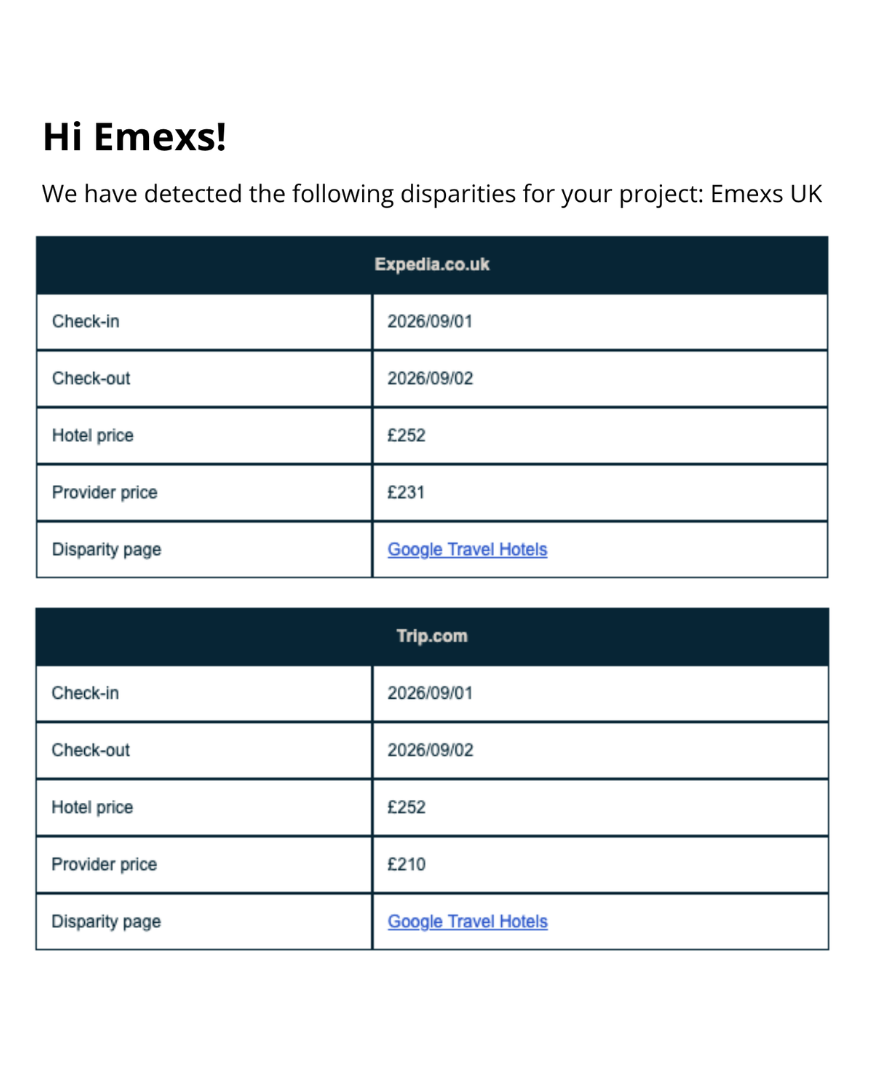

Percentage of channels with detected discrepancies at any given time, frequency of occurrence, average time to correction, and its relationship to the direct sales share.
The resulting operational rule is simple to state but difficult to follow without measurement: without effective parity, closing a channel to boost direct sales doesn’t work; it just leaves the room empty. Customers who shop around will continue to notice the inconsistency, and so will the system.
Consistency to compete, courage to win
It’s important not to get this confused. Consistency eliminates the reasons for not booking with you. But removing objections is not the same as providing reasons. A direct channel without inconsistencies is one where you can already compete; it’s not yet one that customers choose to use.
To do that, your own channels need real value-driven purchase incentives: tangible reasons to book directly that OTAs can’t match. The “best rate guarantee” is the best-known, but not the only one: exclusive perks (upgrades subject to availability, late check-out, welcome gifts), flexible cancellation and payment options, and extras that only you can offer because you know your product. The goal isn’t just for the price to be right, but for the guest to trust you and fall in love with booking with you.
And there’s one nuance that ties into all of the above: the incentive has to be genuine. A “best rate guarantee” that turns out to be cheaper elsewhere isn’t an incentive, it’s a discrepancy with a catch. It’s a promise that the data contradicts, and both the customer and the model see it for what it is: yet another reason not to trust it. The value you offer and the consistency with which you uphold it are one and the same.
What to do
There's nothing new to invent. We have to do well what we've always known we had to do, and now there's no room for error:
-
One name and one category across all channels. It's the cheapest thing to fixand the most overlooked.
-
Real-time, continuously monitored parity, not manually checked every fifteen days.
-
Content consistency: the same current photos, the same services, and the same terms and conditions, whether viewed by the customer or the machine.
-
Quick fix: The key isn't in detecting the discrepancy, but in resolving it before it spreads.
-
Real purchase drivers on your channels: best rate guaranteed, exclusive benefits, flexibility. Valuable reasons to book directly, as long as they are accurate and consistent with other channels.
Consistency isn't what makes you win. It's what allows you to compete. Without it, everything else (your award-winning website, your reputation, your content strategy) is just talking to a machine that has already decided not to trust you.
Frequently asked questions
Can a single discrepancy cause the AI not to recommend me? Not automatically or guaranteed, but it does reduce the model's confidence in your information. The more inconsistencies you accumulate, the more likely it is to prioritize a competitor with consistent data.
Is this the same as the traditional rate parity? It's an evolution of it. Price parity remains the foundation, but AI also evaluates the consistency of names, services, terms, and content across all your sources.
How do I know if I have discrepancies right now? By continuously checking your listings on OTAs, metasearch engines, and your own website, ideally using a tool that monitors them automatically rather than performing occasional manual checks.
Does closing the OTA solve the problem? No, not if there's no price parity. Customers who shop around will still find price discrepancies on other channels, and you'll lose the booking without gaining the direct reservation.
Who is responsible for these disparities, Marketing or Revenue? Both. Marketing feels the effects on direct sales, and Revenue has the leverage to correct them. The challenge isn’t one of attitude, but of technique: monitoring price parity across dozens of channels in real time requires precision and continuous monitoring that manual checks simply can’t provide. That’s why it’s best to treat this as a joint effort supported by tools, rather than as an isolated task for a single department.
Written by Maximiliano Viale, CEO of EMEXS Marketing, a digital solutions agency for the hospitality industry that offers proprietary AI-powered software for price disparity management and visibility.
