From AI-generated content to live streaming: pricing, content, disparities, data and campaigns
SCROLL
For years, much of the digital discussion in the hotel industry has focused on increasing visibility, improving Google rankings to attract traffic, and reducing reliance on third parties.


The emergence of AI changes part of the game, but it doesn’t alter the underlying logic. Although the official website may gain more prominence as the final destination of the click, that doesn’t guarantee that every click will turn into a direct and profitable booking.
That’s why the real challenge lies in the commercial strategy. The new challenge is to ensure that, once the user arrives at the website, it functions as a real sales tool.
The new value chain: being mentioned, selected, clicked, and converting
In the AI environment, the user journey can be summarized in four steps:
- The model identifies signals about the hotel from multiple sources.
- It considers it a suitable option for a specific query.
- It decides which destination to link to.
- The user compares, confirms, books, or leaves.
Currently, most hotels focus on the first step and some on the third, but very few effectively address the fourth. However, that is where direct sales are won or lost.
AI does not replace human judgment; rather, it filters and shifts it. Nor does it eliminate economic considerations; it recontextualizes them. Therefore, far from replacing hotel marketing, it forces it to be more explicit, consistent, and measurable.
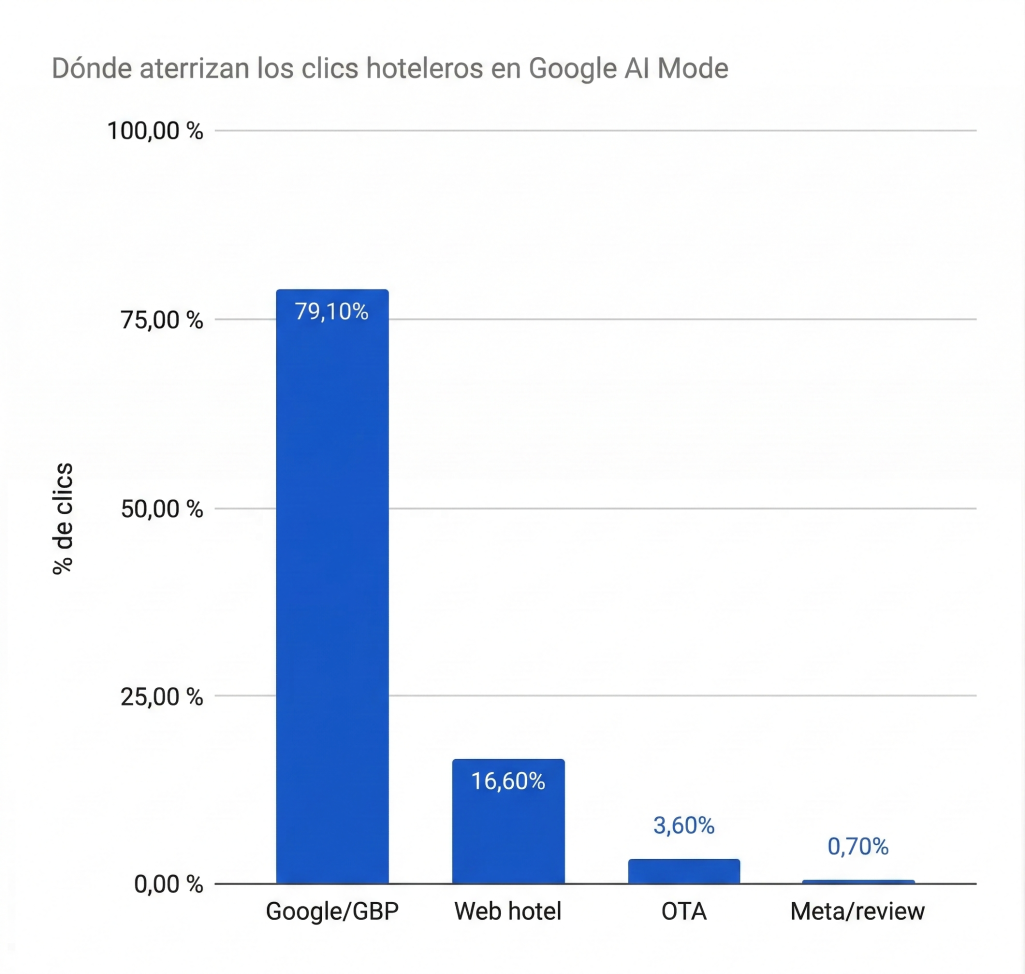

Should we display prices on the website?
Yes, but the important question is “how” to do it and what role they play in the value proposition. Displaying prices on the website helps for three reasons:
- Reduce friction for the user. If a visitor arrives at the website and takes too long to understand the price range, terms, or benefits, they will look for a platform where comparison is easier.
- Improve the interpretability of systems. Google clearly documents the use of structured data for hotel prices to explain, validate, and display pricing information in detail. Furthermore, it emphasizes that this data must be machine-readable and match what the user sees.
- Strengthens control over the comparison landscape. When a hotel clearly presents its price, inclusions, and direct booking benefits, it stops competing solely on price and begins competing on perceived value.
Therefore, it’s important to establish a clear pricing strategy. But this doesn’t necessarily mean displaying a single, fixed price everywhere on the website. What’s useful is to build a structure where both users and systems clearly understand:
- The price
- What’s included
- Variations by room type or rate plan
- Benefits of booking directly
- Why that price makes sense
Price alone doesn’t win. The value proposition wins
One of the major weaknesses of a hotel’s own website is trying to compete with an OTA by copying its style: same photos, same descriptions, same rates, and same sales pitch. In that arena, the OTA usually has the upper hand.
A hotel’s own website starts to win when it changes the rules of the game. When it doesn’t just show the rate, but also explains why guests should choose that hotel.
That means focusing on:
- Rational value: location, room types, amenities, policies, flexibility, direct benefits, packages, upgrades, breakfast, parking, and cancellation policies.
- Emotional value: design, atmosphere, narrative, style, the feel of the stay, and details that create desire.
- Commercial value: clarity in the proposal, calls to action, well-managed urgency, favorable comparisons, guarantees, and trust.
Content: less text and better sales signals
When people talk about AI, they often assume that “we’ll need more content for it to understand us.” In reality, however, what’s needed are better signals, ones that are more structured and aligned with the user’s intent.
Google emphasizes that AI experiences continue to be based on the same fundamentals: useful content, page experience, technical accessibility, and consistency between structured data and visible content. There is no such thing as AI SEO that exists separately from business reality; rather, greater clarity is required.
For a hotel, this means reviewing its content strategy on multiple levels:
Discovery layer
Texts that clearly explain: what type of traveler the hotel is designed for, what areas it serves, what experience it offers, and what features set it apart from the competition.
Validation layer
Content that builds trust: clear policies, frequently asked questions, well-defined services, booking terms, testimonials, and a reputation that aligns with what is promised.
Conversion layer
Visible promotional messages, benefits of booking directly, reasons to choose your property, included amenities, favorable comparisons, and calls to action that don’t require the user to figure out the value on their own.
The page shouldn’t be filled with generic text; instead, it should effectively answer specific questions and turn the hotel’s features into compelling selling points.
The Discrepancy: from revenue to credibility
A hotel can invest in SEO, content, AI-driven visibility, campaigns, and design. But if, when a user compares options, they find better terms or a lower price elsewhere, much of that effort is wasted. This discrepancy not only hurts conversion rates but also erodes trust in the direct channel.
In this new context, this is significant for two reasons:
- Google uses signals related to landing page experience and price accuracy within the hotel ecosystem.
- Users arriving via an AI recommendation have less patience and higher expectations for consistency.
Google is explicit: price accuracy affects the ranking of ads and free booking links. A poor landing page experience not only reduces conversion rates but also impacts visibility on key platforms.
Does it make sense to compete with OTAs through your website?
The effective solution isn’t to turn your site into a poor-quality OTA. It’s to build a better-defined alternative with:
- Clear pricing
- A visible unique selling proposition
- Exclusive benefits
- A superior experience
- Consistency between promise and reality
When the hotel sets the benchmark for comparison, the conversation shifts away from focusing solely on price and instead highlights the benefits and exclusivity of the direct channel compared to OTAs.
This becomes even more powerful when combined with packages, unique advantages, flexibility, added value, and a brand experience that enhances desirability.
Data and analysis are now non-negotiable
Given this scenario, simply measuring traffic is no longer enough; you need a combined analysis of Search Console, Analytics, the booking engine, Google Hotels, and distribution channels to answer much more useful questions:
- Which search queries are losing CTR, and which ones still indicate booking intent?
- Which landing pages convert better when the user has already narrowed down their options?
- How much do brand and non-brand searches contribute to the decline or recovery?
- Which pages serve as validation and which as sales?
- Where does the funnel break down: at the click, the price, the search engine, trust, or price disparity?
Google explicitly recommends using Search Console and Google Analytics together to understand what happens before and after the click. This integration is even more important now that interactions from AI features are included in overall search traffic.
A hotel that doesn’t track this data with sufficient granularity runs a twofold risk: misdiagnosing the problem and misallocating its budget.
Campaigns in this new context
Campaigns should no longer be viewed solely as a means of attracting new customers. They should also serve to:
- Protect the direct channel
- Highlight the hotel’s unique value proposition
- Re-engage users who have discovered the hotel but haven’t booked
- Support comparison sites where price and accuracy matter
Here are three particularly useful approaches:
1. Brand protection
If AI and Google generate more hybrid journeys that blend inspiration, comparison, and product details, protecting high-intent brand demand remains key.
2. Google Hotels and free booking links
If the hotel can effectively provide accurate pricing and availability, these platforms become a natural extension of the direct sales strategy.
3. Remarketing and conversion
Users who arrive highly qualified via AI may need a second touchpoint, not necessarily an initial explanation. This changes the tone of campaigns, landing pages, and messaging.
Campaigns, therefore, no longer just generate volume; they become a tool for conversion and margin protection.
The Website as a sales tool: What it really needs to include
If a hotel wants to improve its conversion rates in this environment, its website must be much more explicit in five key areas:
- An unambiguous official source
- A memorable emotional appeal
- Useful and well-structured content
- Transparent pricing and terms
- A visible and credible direct benefit
The website must be convincing: it should answer questions, guide users, and justify the price. In other words, it should focus on being the best place to book a hotel.
A practical roadmap for the next 90 days
If we had to prioritize the work, the order would be as follows:
1. Review the commercial foundation
- Visible direct benefits
- Price clarity
- Consistency between the website and the booking engine
- Value proposition by traveler type
2. Address conversion friction
Such as speed, mobile experience, navigation, CTAs, booking engine steps, trust, and policy clarity.
3. Optimize signals for AI and search engines
- Useful content
- Clear architecture
- Structured data where applicable
- Alignment between visible content and marked-up data
4. Control price discrepancies and accuracy
Especially on Google Hotels, free booking links, and major OTAs.
5. Measure more effectively
- Brand vs. non-brand
- Query intent
- Landing pages
- Conversions and assisted conversions
- Post-click behavior and traffic quality
Conclusion
Although AI can help the official website connect better with customers, direct sales aren’t won through the link itself—they’re won through the quality of the brand’s own channel. That’s why the real question to consider when developing a strategy is: When users arrive at the official website, do they find a better reason to book?
- If the answer is yes, AI can become a powerful ally.
- If the answer is no, we’ll just be driving clicks to a website that still isn’t capitalizing on its opportunity.
